

Database Backup Restore Testing That Runs Itself
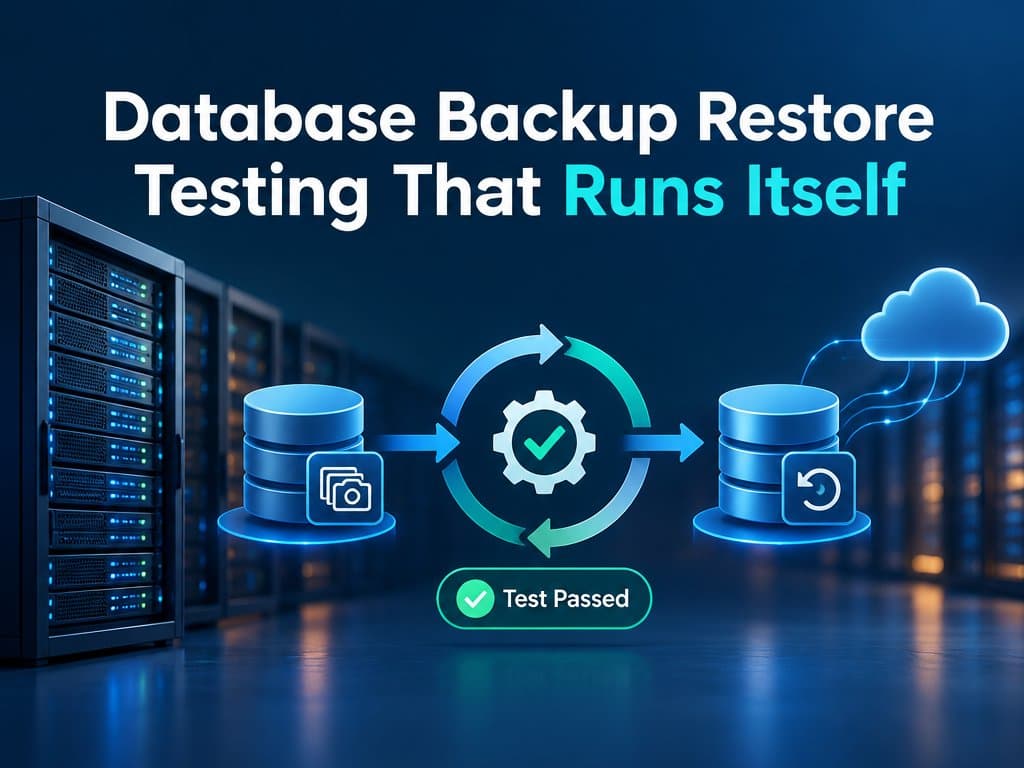
A backup job that says success proves almost nothing. Here is how to automate a restore drill that verifies integrity, RPO, RTO, and real application queries.
Database Backup Restore Testing That Runs Itself
Your backup job has been green for fourteen months. Then a bad migration drops a table, you reach for the backup, and the restore fails. The dump was truncated. The encryption key was rotated and the old one is gone. Or the restore works, but the application cannot start because a required extension was never installed on the target.
None of those failures show up in a backup log. They only show up in a restore.
I have seen this on VPS setups that looked perfectly healthy, which is why I treat a backup as unfinished until a restore has run. The VPS backup strategy that actually protects your data covers the storage side; this post covers the proof.
This guide is about database backup restore testing that runs on a schedule, without a human, and fails loudly when the backup is not actually usable. By the end you will have a drill you can run weekly and a short list of assertions that catch the failures a green checkmark hides.
Tip
TL;DR — Restore the latest backup into an isolated target, verify structure and data against a baseline, run a real read query, measure the data-loss window and the time to usable service, then tear it all down. Alert on the test itself, not just the backup job.
What database backup restore testing actually proves
A backup job proves one thing: the tool managed to write bytes somewhere. It does not prove the bytes are readable, complete, encrypted with a key you still have, or compatible with the version of the database you will restore into.
The common failure modes are boring and predictable:
- The dump process was killed halfway and the file is short.
- The backup includes the database but not the roles, extensions, or sequences the app needs.
- Retention deleted the only copy that matched the transaction log you needed.
- The encryption key lived in the same vault as the database credentials and both rotated together.
- The restore target has a different major version and the dump will not load.
- The backup is fine, but nobody knows how long the restore takes, so the recovery time objective was fiction.
Every one of these survives a "backup completed" event. Only a restore catches them.
Define RPO and RTO before you pick a tool
Two numbers decide how much engineering you need.
Recovery point objective (RPO) is the maximum data loss you can accept, measured in time. If the RPO is fifteen minutes, you need backups or log shipping at least that often.
Recovery time objective (RTO) is the maximum time until the service is usable again. Not until the database process starts. Until the application can serve traffic. The AWS Well-Architected guidance on periodic recovery testing is a useful reference for the validation criteria.
Most teams write these numbers in a document and never test them. The restore drill exists to turn them into measurements.
Important
Measure RPO from the newest record the restored application can actually read, not from the timestamp on the backup file. Measure RTO from the incident decision to the moment a real request succeeds, not from the restore command's exit code.
A practical starting cadence:
| System tier | Full restore test | Quick integrity check |
|---|---|---|
| Critical (payments, auth) | Weekly | After every backup |
| Important (core product data) | Monthly | After every backup |
| Low (analytics, archives) | Quarterly | Weekly |
If weekly feels expensive, compare it to the cost of discovering a broken backup during an outage.
The restore test loop: five checkpoints
Treat verification as a loop, not a one-off project.
- Define the promise. Write down RPO and RTO per database. Name an owner.
- Capture the artifact. Record which backup file, which transaction log range, and which encryption key were used.
- Restore to an isolated target. Separate credentials, separate network, no production writes.
- Compare against a baseline. Structure, row counts, recent keys, and control totals from the same recovery point.
- Rehearse the response. If the test fails, the alert must say what failed and who owns the next step.
The restore is the decisive step, but it is not the finish line. The test passes only when the application can use the recovered data safely.
Automate the drill
Here is a minimal PostgreSQL drill you can adapt. It restores into a throwaway container, using the same approach as how to dockerize an application, runs checks, and exits non-zero on failure.
#!/usr/bin/env bash
# scripts/restore-drill.sh
set -euo pipefail

BACKUP_FILE="${1:?usage: restore-drill.sh <backup.dump>}"
TARGET="drill-postgres-$(date +%s)"
CONTAINER_PORT=55432

cleanup() {
  docker rm -f "$TARGET" >/dev/null 2>&1 || true
}
trap cleanup EXIT

start=$(date +%s)

docker run -d --name "$TARGET" \
  -e POSTGRES_PASSWORD=drill \
  -p "$CONTAINER_PORT:5432" \
  postgres:16-alpine >/dev/null

until docker exec "$TARGET" pg_isready -U postgres >/dev/null 2>&1; do
  sleep 1
done

docker exec -i "$TARGET" \
  pg_restore -U postgres -d postgres --no-owner --exit-on-error < "$BACKUP_FILE"

# 1. Structure: required tables must exist
docker exec "$TARGET" psql -U postgres -tAc \
  "select count(*) from information_schema.tables
   where table_schema = 'public'
     and table_name in ('users','orders','invoices','payments');" \
  | grep -qx 4

# 2. Data: control total from the same recovery point
docker exec "$TARGET" psql -U postgres -tAc \
  "select coalesce(sum(amount_minor),0) from payments
   where occurred_at < '2026-11-01T00:00:00Z';" \
  | grep -qx "$EXPECTED_PAYMENTS_TOTAL"

# 3. Application: a real read path
docker exec "$TARGET" psql -U postgres -tAc \
  "select count(*) from orders where status = 'open';" \
  | grep -qE '^[0-9]+$'

end=$(date +%s)
echo "restore_seconds=$((end - start))"
Three details make this useful in practice:
--exit-on-errorstops on the first bad object instead of producing a half-restored database.- The control total comes from the same recovery point, not from live production. Comparing to a moving system guarantees false failures.
- The container is thrown away in a
trap, so a failed drill does not leave test data lying around.
For MySQL, the shape is the same with mysql and mysqldump. For MongoDB, use mongorestore and assert collection counts. If you run containers in production, the Dockerized MongoDB replica-set drill is a useful reference. The tool changes; the checkpoints do not.
What to assert after the restore
Structure checks alone are not enough. A restore can load every table and still be useless.
Use three layers:
- Structural: schemas, tables, indexes, roles, extensions, and sequences exist.
- Data: row counts within an agreed range, recent primary keys, and totals for high-value tables match the baseline.
- Application: read-only queries that mirror real paths, such as the latest paid invoice, an active subscription, or a ledger total.
Write down the accepted variance before the test. A replica taken at a different timestamp will not match live production row for row. Compare it to the correct recovery-point baseline, and treat every unexplained delta as a failure until an owner closes it.
Warning
A restore that exits with code zero can still be incomplete. Never let the exit code be your only assertion.
Isolate the restore target
A drill that writes to production is not a drill. It is an incident with extra steps.
The target environment should:
- use separate credentials and a separate network boundary,
- have outbound email, SMS, and payment providers disabled,
- not replay production webhooks or scheduled jobs,
- not write to production object storage prefixes,
- be destroyed automatically, with a check that it actually was.
If your application starts background workers on boot, disable them in the drill configuration. The most common drill incident I have seen is a restored copy sending real emails to real customers.
Alert on the test itself
The drill is only valuable if silence is impossible. A test that stops running is worse than no test, because it manufactures confidence.
Emit a small result record every run: timestamp, backup artifact, duration, checks passed, checks failed, measured RPO, measured RTO. Then alert on three conditions:
- the drill did not run when expected,
- the drill failed,
- the measured RTO exceeded the objective.
Keep the results long enough to see drift. A restore that took four minutes last quarter and takes nineteen today is a warning, even if it still passes.
Wrapping Up
Backups are a promise; restore tests are the evidence. Define RPO and RTO, restore into an isolated target on a schedule, assert structure, data, and a real application query, and alert when the drill itself breaks.
Start with one critical database this week. A single honest drill teaches you more than another year of green checkmarks.
Running production systems on your own infrastructure? See the production systems I build or get in touch if you want a second pair of eyes on your recovery plan.
Related Posts
Related Articles
Rate Limiting and Caching at the API Gateway Layer: Protecting Your Backend From Its Own Traffic
Most outages aren't attacks, they're your own traffic overwhelming itself. A concept-first look at how rate limiting and caching work together at the API gateway to keep one misbehaving client, integration, or traffic spike from degrading service for everyone else.
The Backup Strategy That Actually Protects Your VPS Data (And Why Automation Isn't Optional)
Manual backups fail under pressure, and unmonitored automated ones fail silently. A layered VPS backup strategy, the 3-2-1 rule, application-aware dumps, encrypted off-site transfer, dead-man's-switch monitoring.
Backup Strategy for a Dockerized MongoDB Replica Set: Disaster Recovery You've Actually Tested
A replica set isn't a backup — it protects against a dead node, not a dropped collection or a bad migration. Here's the mongodump/oplog setup I actually run against a Dockerized MongoDB replica set, why restore testing is the step everyone skips, and when to graduate to filesystem snapshots or PBM i