

ERP vs. Custom Software for Egyptian SMEs: When the E-Invoice (ETA) Mandate Changes the Math
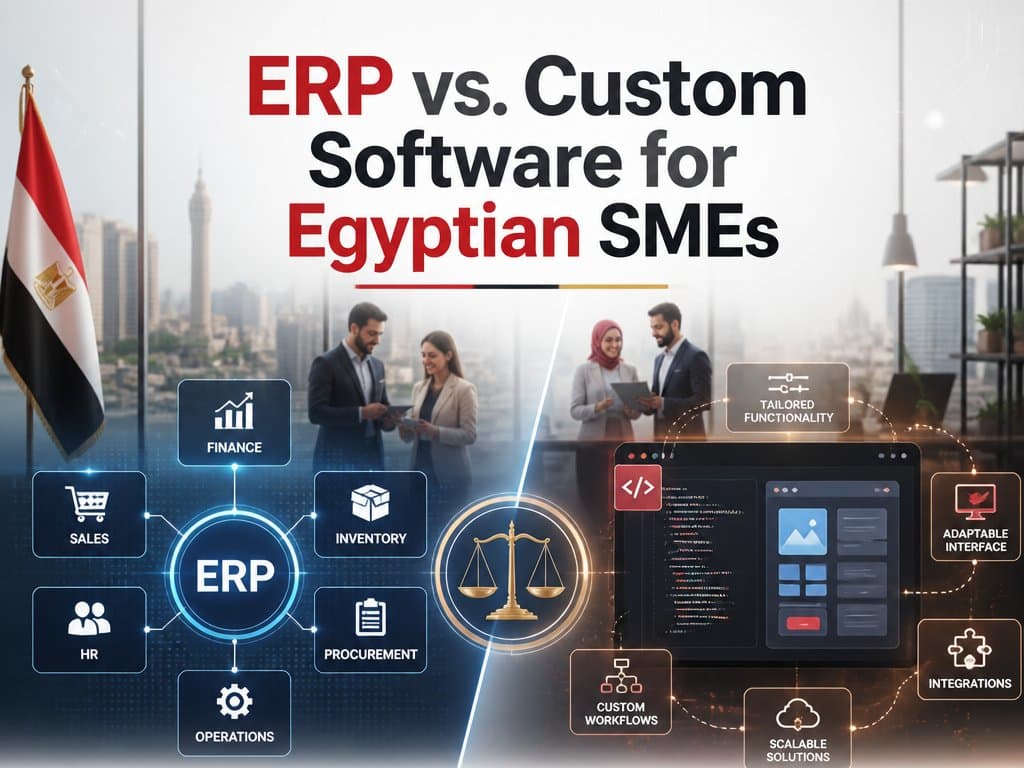
Egypt's e-invoicing mandate stopped being a compliance formality and became a live, real-time integration with the ETA platform — and that shift quietly changes the ERP-vs-custom calculus for Egyptian SMEs.
ERP vs. Custom Software for Egyptian SMEs: When the E-Invoice (ETA) Mandate Changes the Math
For years, the ERP-vs-custom decision for an Egyptian SME came down to budget and flexibility: a custom system was cheaper to start, matched your exact workflow, and avoided paying for features you'd never use. An off-the-shelf ERP cost more upfront but came with a support ecosystem and someone else's problem to maintain. That trade-off held up reasonably well, right up until the Egyptian Tax Authority made e-invoicing a real-time, mandatory compliance system instead of a paperwork formality, and quietly moved the goalposts for what "custom software" actually has to include.
I'm Khalid Arafa, and I build CRM and ERP systems for SMBs across Egypt and the Gulf. The question I've been getting more often in the last year isn't "should we build custom or buy ERP" in the abstract, it's "can our custom system even stay compliant with ETA," and the honest answer, for a lot of businesses, has started to tilt back toward ERP in a way it didn't three years ago.
Tip
TL;DR, Egypt's e-invoicing mandate now covers effectively every VAT-registered business, after the registration threshold dropped from EGP 500,000 to EGP 250,000 in annual revenue starting January 2026, with B2C e-receipts required in real time alongside B2B e-invoices. That mandate isn't a form to fill out, it's a live integration with the ETA platform: digital signing, structured XML/JSON submission, UUID validation, and (for retail) a 72-hour B2C reporting window. Established ERPs increasingly ship this integration built in. Custom software has to build and maintain it as its own ongoing compliance product. That shift in cost is the actual math that's changed.
What the mandate actually requires, past the headline
"Egypt requires e-invoicing" undersells what the system actually does. Every B2B invoice has to be created in a structured format, digitally signed, and transmitted to the ETA platform for real-time validation before it's legally valid, a paper or informally-generated invoice no longer qualifies for input VAT deduction at all. On the consumer side, the mandate has expanded to require e-receipts for B2C transactions as well, submitted to ETA within a fixed window after the sale, with a QR code on the printed receipt so both the customer and an auditor can verify it against the ETA record.
None of that is a checkbox. It's a live API integration your invoicing or point-of-sale system has to maintain correctly, indefinitely, because a broken integration doesn't just cause an inconvenience, it means invoices your business is issuing aren't legally valid until the connection is fixed.
The threshold change that pulled in the SMEs who thought this didn't apply to them
A lot of small businesses reasonably assumed e-invoicing was an enterprise problem. That assumption stopped being safe on January 1, 2026, when the mandatory registration threshold dropped from EGP 500,000 to EGP 250,000 in annual revenue, pulling tens of thousands of smaller businesses and sole proprietors into scope for the first time, with a registration deadline of March 31, 2026, and real financial consequences for missing it. This is the detail that quietly reframes the entire ERP-vs-custom conversation for Egyptian SMEs: it's no longer a decision only larger companies have to think about.
Why this changes the ERP-vs-custom math specifically
Before the mandate tightened, "custom software" for an Egyptian SME meant building the business logic your workflow actually needed, inventory, invoicing, customer records, without paying for a bloated general-purpose platform's unrelated features. That's still a legitimate reason to build custom. What's changed is what "invoicing" now quietly implies as a requirement: not just generating a document, but maintaining a compliant, continuously-tested integration with a government tax platform that issues its own schema updates, enforcement waves, and penalty structures on its own timeline, not yours.
| Off-the-shelf ERP (with ETA module) | Custom-built software | |
|---|---|---|
| ETA compliance | Often pre-built and maintained by the vendor as part of the product | Has to be built in-house or contracted separately, and maintained indefinitely |
| Cost exposure as ETA rules evolve | Vendor absorbs and ships schema/rule updates | Your team absorbs every future ETA rule change as new development work |
| Fit to your exact workflow | Good, sometimes requiring configuration around the platform's assumptions | Excellent, built around exactly how your business operates |
| Upfront cost | Licensing plus setup, generally lower for SMEs on open-source options | Development cost, which now has to include the compliance layer, not just business logic |
| Risk if compliance integration breaks | Vendor's problem to fix, usually under a support agreement | Your problem, and yours to fix fast, invoices are invalid until it's working again |
| Long-term flexibility | Bounded by what the platform allows | Unbounded, but every future feature, including compliance ones, is a build |
Neither column is automatically the right answer, it depends on how much of your software's remaining value is actually about your unique workflow versus how much of it is now just "correctly talk to a government API," which is not a differentiator for any business, no matter how well it's built.
Where custom software still wins, even with the mandate in place
The mandate doesn't make custom software the wrong choice, it removes one argument that used to favor it by default. Custom still makes sense when a business's core workflow genuinely doesn't map onto what general ERPs assume, in the same way I've written about specialized versus general-purpose CRM: a business whose real complexity is in scheduling, multi-branch service delivery, or an industry-specific process gains little from an ERP's invoicing module being pre-built, if that was never the hard part of the problem in the first place. In that case, the right move is usually a custom core system with the ETA integration handled through an authorized third-party signing service or a well-maintained open-source connector, rather than reinventing compliance logic that has to track a government schema by hand.
The businesses where this calculation shifts hardest are the ones whose core workflow actually is invoicing, retail POS, or accounting-adjacent, where an ERP's compliance module isn't a feature bolted onto something else, it's most of what the software needs to do well in the first place.
A simple decision model
Lean toward an ERP with a built-in ETA module if: your core operations are largely standard (inventory, invoicing, basic accounting), and you'd rather pay a vendor to keep pace with ETA's rule changes than assign that work to your own team indefinitely.
Lean toward custom software, paired with a dedicated e-invoicing integration or signing service, if: your actual operational complexity is elsewhere, scheduling, service delivery, a workflow no general ERP models well, and invoicing compliance is a necessary layer, not the product itself.
Reassess now, regardless of which path you're on, if: your revenue crossed EGP 250,000 in 2025 and you haven't registered, since the registration deadline and the newly-lowered threshold apply whether or not your current software was ever built with compliance in mind.
Wrapping up
The ERP-vs-custom decision for Egyptian SMEs hasn't been settled by the ETA mandate, it's been reframed by it. Compliance used to be a small, bounded piece of either option. Now it's a live, evolving integration with real financial penalties for getting it wrong, and that changes which parts of "build it ourselves" are actually saving money versus which parts are quietly becoming a second product your team now has to maintain forever. The right call still depends on where your business's real complexity sits, but for the first time, that answer has to include an honest accounting of who's responsible for keeping up with a government API that updates on its own schedule.
This is the same underlying question I worked through in specialized vs. general-purpose CRM, matching the software's core assumptions to what your business actually does, and the cost side of build-vs-buy is covered in more depth in the Zoho vs. custom stack cost comparison.
Related Posts
Related Articles
ERP Implementation Cost in Saudi Arabia: What the Licence Price Hides
The licence is about a third of the bill. Data migration, ZATCA integration, Arabic localisation and training are the rest — here is how to price them.
ZATCA Phase 2 Integration: A Technical Guide for Saudi Businesses
What ZATCA Phase 2 integration actually requires from your ERP or POS — the XML, the cryptographic stamp, the API calls, and where it breaks.
Qoyod vs Daftra vs Odoo vs Custom: Which Actually Fits a Saudi SMB?
Four different answers to the same problem. Here is which one fits which business, and the revenue point where each stops making sense.