
Why Furniture, Metal, and Signage Workshops Outgrow Standard ERP Software
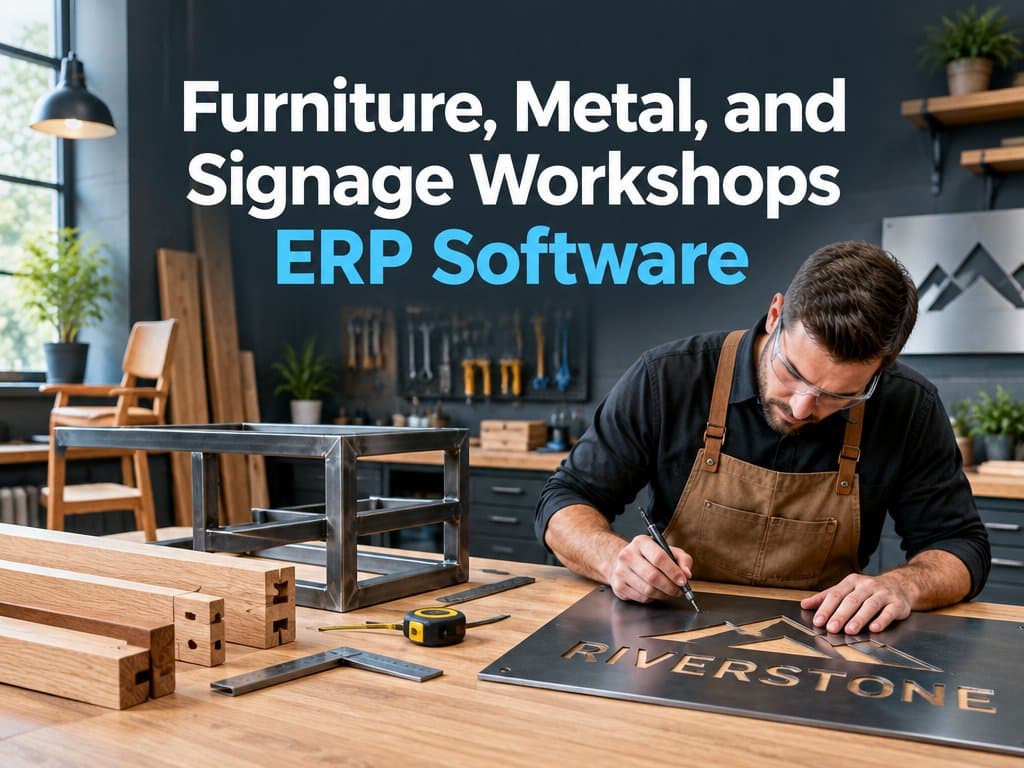
Every workshop order is different, but standard ERP assumes repeat products. Learn why quotes, materials, changes, and job costs slip—and when a process-built system pays off.
Why Furniture, Metal, and Signage Workshops Outgrow Standard ERP Software
A customer approves a quote for a custom reception desk, changes the finish halfway through production, and asks for delivery before a date your team never promised. Your standard ERP still shows the original materials and price, while the workshop manager tracks the real job in a notebook. Made-to-order workshops outgrow standard ERP software when the system assumes every sale is the same product repeated at a fixed price.
The answer is not automatically a custom system. First, understand where the standard process breaks, what information the owner needs, and whether a tailored workflow will cost less than the workarounds it replaces.
Tip
TL;DR: Track each custom job from approved quote through changes, materials, actual cost, and delivery. Keep standard ERP when it handles that flow without duplicate spreadsheets.
The real workflow in a made-to-order workshop
Most jobs move through a sequence: receive a request, clarify requirements, prepare a quote, get customer approval, reserve or buy materials, schedule production, record changes, inspect the result, arrange delivery, and invoice the customer. A furniture maker may need measurements and fabric choices; a metal shop may need material grade and finish; a signage business may need artwork approval and installation details.
The job is the unit that connects sales to production and finance. The quote is not just a price: it records assumptions about quantity, dimensions, materials, labor, delivery, and what is excluded. Once a customer approves it, the workshop needs to know which version is approved and which later requests change the cost or deadline.
Where standard ERP software breaks
A general ERP is often designed around a catalog item with a known price, stock level, and repeatable assembly. That works well for products made in batches. A one-off job may not have a permanent item code, and its material list can depend on a drawing that changes after the quote. Some systems can handle this, but only through extra modules, complicated configuration, or rules that no one on the shop floor understands.
Changes mid-order are a common gap. If the customer asks for a different material, someone must update the quote, purchasing list, job instructions, and delivery date. When those records do not share one job reference, the old specification can remain on a printed sheet. The result may be wasted material, a rework visit, or an argument over whether the extra request was included in the original price.
One-off materials cause another problem. A job may need a special fitting, a sheet size that is not normally stocked, or a finish ordered only for one customer. If the system treats every purchase as general inventory, it becomes difficult to tell which job used the item or whether the cost was included in the quote. Owners often end up back in Excel because a spreadsheet is flexible enough to list the exceptions.
Why owners return to Excel—and how hidden costs add up
Excel is not necessarily the mistake. It is often the quickest way to record a field the ERP does not capture. The trouble starts when the spreadsheet becomes a second source of truth: sales changes the quote in one file, production reads another, and accounting only sees the final invoice. Staff spend time reconciling versions instead of moving the job forward.
Quoted price alone does not show whether a job made money. To understand the result, compare the approved price with actual material purchases, production hours, subcontracting, delivery, and rework. If extra work is given away without recording it, the owner may blame low margins on material prices when the real cause is unapproved scope changes. A clear change record lets the team explain a revised price and delivery date before the work continues.
What a custom workshop flow should track
A useful system starts with a job number shared by the quote, customer approval, material purchases, work instructions, delivery note, and invoice. It stores the approved drawing or specification with a version and date, then records each change as a request with its effect on price and schedule. Staff can see the current approved version without searching message threads.
For each job, track estimated and actual material cost, planned and actual labor time, outside services, delivery, and waste or rework where relevant. The owner can then compare quoted margin with the result and learn which job types are consistently underpriced. This is not a demand for workers to enter every minute of the day; capture information at practical milestones, and use simple categories that make sense on the shop floor.
The same view should show the next action and its owner: customer approval needed, material arrival expected, production queued, inspection due, or invoice ready. A dashboard that shows ten overdue jobs is less useful than a list explaining what is blocking each one and who can unblock it.
Example: a signage company with mid-order changes
Suppose a signage shop quotes a set of exterior signs based on standard aluminum and one installation visit. After approval, the customer requests a new finish and changes two sign dimensions. With a job-centered flow, the coordinator records the requested revisions, asks production and purchasing about the material effect, and issues a revised quote and delivery estimate for approval. Production continues against the last approved design, not a drawing buried in chat.
When the finish is purchased, its cost is attached to that job. After installation, the team compares the actual material and labor with the estimate. If several similar jobs show the same cost overrun, the next quote can reflect the real pattern. One example will not prove a system's return; track enough completed jobs to see whether fewer changes are missed and estimates improve.
When standard software is still the right choice
A standard ERP may be a better fit if most of your workshop sells repeat products, its order and costing process matches your work, and a small configuration covers the exceptions. It is also sensible when you need mature accounting, inventory, or purchasing features and do not have anyone available to own a custom system. A familiar tool with a few disciplined spreadsheets can be cheaper than building and maintaining new software.
Before replacing anything, ask the vendor to demonstrate a real job from quote through final invoice, including a customer change, one-off material, and rework. Count additional licences, setup, support, and the time needed to keep workarounds accurate. If the demonstration uses only a perfect, unchanged order, it has not answered the question that matters.
A quick comparison
| Approach | Best fit | Main trade-off |
|---|---|---|
| Standard ERP | Repeat products and common processes | Exceptions may need workarounds |
| ERP plus a controlled job sheet | A few unusual orders | Staff must keep records aligned |
| Job-centered custom flow | Frequent changes and job costing gaps | Requires an owner and ongoing support |
Workshop ERP checklist
- Can every quote, purchase, work instruction, delivery, and invoice share one job number?
- Can the team distinguish an approved specification from a requested change?
- Are one-off materials and outside services charged to the correct job?
- Can the owner compare quoted and actual costs without a month-end spreadsheet hunt?
- Does the system show the current blocker and its owner?
- Can the vendor demonstrate the messy jobs, not just repeat products?
- Is a standard product process sufficient for most orders today?
Wrapping Up
Made-to-order shops need a reliable link between the promise in the quote and the work that actually reaches production. Standard ERP can be enough when the process fits; when it does not, a job-centered workflow can reduce rekeying, missed changes, and invisible costs. Start by measuring the gaps on completed jobs before deciding what to replace.
Book a free 30-minute call to map your workshop workflow.