

Ahrefs vs Semrush: Which SEO Tool Is Actually Worth Your Budget in 2026
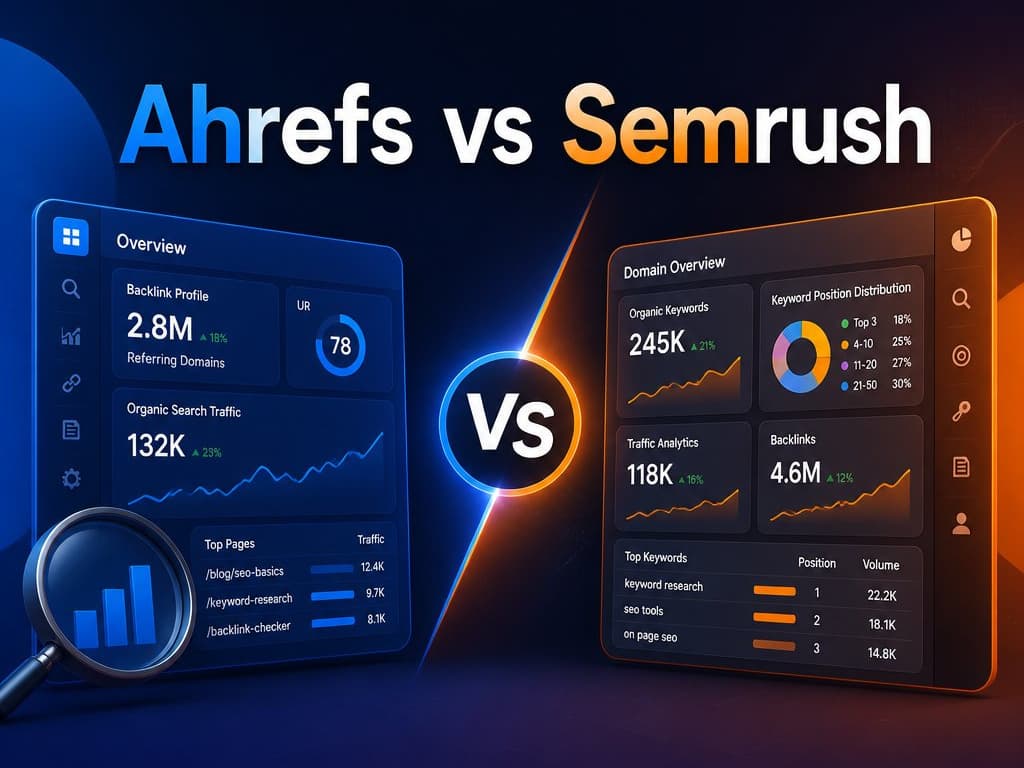
I run SEO for my own site and for client CRM/ERP projects across the Gulf, which means I've had a paid seat on both Ahrefs and Semrush at the same time for most of this year. So this isn't a features page rewritten with new adjectives — it's what changed when I actually had to pick one for a client
Ahrefs vs Semrush: Which SEO Tool Is Actually Worth Your Budget in 2026
I run SEO for my own site and for client CRM/ERP projects across the Gulf, which means I've had a paid seat on both Ahrefs and Semrush at the same time for most of this year. So this isn't a features page rewritten with new adjectives — it's what changed when I actually had to pick one for a client with a fixed monthly tools budget.
Ahrefs vs Semrush isn't really "which is better." It's two different jobs. Ahrefs is a link-and-research specialist built around the deepest backlink index in the industry. Semrush is a full marketing suite that happens to include excellent SEO tools, plus PPC, social, and — as of 2026 — AI-visibility tracking. Picking the wrong one for your actual workflow means paying for a suite you don't use, or hitting a wall the tool was never built to cross.
Tip
TL;DR — If backlink analysis and competitor link research drive your work, Ahrefs wins on data depth and price. If you run SEO alongside PPC, social, and AI-search tracking on one team, Semrush's breadth justifies the higher bill. If you genuinely can't decide, that's usually a sign your team is doing both jobs — and a lot of agencies quietly run both tools rather than compromise on either.
Before the numbers: most "Ahrefs vs Semrush" articles online are written by affiliates, and Semrush pays a real commission per signup while Ahrefs runs no affiliate program at all. That tilts a lot of "verdicts" you'll read elsewhere. I don't sell either tool, and I use both, so take that for what it's worth.
The 2026 pricing snapshot
Both vendors restructured their plans this year, so numbers you may have seen in an older comparison are probably stale. Here's what each vendor's own pricing page showed as of mid-2026.
| Ahrefs | Semrush | |
|---|---|---|
| Entry tier | Starter, ~$29/mo (capped credits) | Pro/SEO Toolkit, from ~$140/mo |
| Core working plan | Lite/Standard, ~$129–179/mo | Semrush One (adds AI visibility), from ~$199/mo |
| Backlink index | Largest in the industry, refreshed every 15–30 minutes | Strong, but not the primary focus |
| Multi-engine tracking | Google-focused | Tracks Google, Bing, and Baidu, with broader SERP-feature coverage |
| Social media tools | Unlimited social publishing and scheduling included in beta | Separate Social product, $20–40/mo for 5–10 profiles |
| Usage limits | Standard tier and above now run on unlimited fair usage per active user rather than the old credit system | No hard credit cap on core plans, but AI tools are gated behind the higher tier |
The gap that actually matters for a small team: Ahrefs' cheapest full plan runs about $129/month against roughly $199/month for Semrush's equivalent tier once you want AI-visibility tracking included. That's not a rounding error over a year — it's the same shape of decision I laid out in the Zoho One vs building your own stack model: the sticker price is the smallest part of the real comparison.
Where each tool actually wins
Ahrefs: the backlink specialist
If your work is competitor link research, disavow audits, or finding link-building opportunities, Ahrefs is built for exactly that job. The index is larger and updates faster than Semrush's, and Site Explorer stays the fastest way I've found to pull a competitor's full referring-domain list without wading through a marketing suite to get there.
Ahrefs also tends to give more tracked keywords per dollar at the entry level than Semrush's equivalent tier, with stronger backlink data attached. For a freelancer or a two-person agency doing pure SEO, that's the whole decision in one line.
Semrush: the all-in-one suite
Semrush is built for full-stack marketers and agencies managing multiple channels from one platform — SEO, PPC, content, social, and now AI-search visibility across ChatGPT and Perplexity, all under one login and one client report. If you're billing a client for "digital marketing" rather than "SEO," the suite pricing starts making more sense than three separate subscriptions.
Semrush also runs daily position tracking with local granularity and covers SERP features more comprehensively than Ahrefs, which matters if local pack rankings or featured snippets are part of what you're reporting on.
The cost nobody puts in the comparison table
This is the part every vendor's own pricing page leaves out, and it's the same pattern I keep running into with every "buy vs build" decision I write about:
1. The tool you actually need lives one tier up. Both platforms gate the feature that made you buy in the first place — AI visibility on Semrush, unlimited credits on Ahrefs — behind their second or third tier, not their advertised entry price.
2. Seats compound. Additional users on Semrush start at roughly $45/month each, and Ahrefs charges per active user too. A three-person team on either tool is paying triple the headline price you saw in the ad.
3. You'll still pay for what the other tool does better. Around 45% of professional SEOs run both tools side by side — Semrush for keyword research, content planning, and site audits; Ahrefs for backlink research and competitor link analysis — because the overlap between them is smaller than either marketing page admits.
4. The credit system is a real cost, not a footnote. Users of both platforms cite the pricing structure itself as a pain point — Ahrefs' credit system specifically gets called out as confusing and expensive for smaller teams. Budget for the plan that actually covers your monthly workload, not the one on the homepage.
Note
This is the same lesson from why I stopped recommending off-the-shelf tools by default — the sticker price and the real monthly cost are two different numbers, and the gap is almost always the tier you didn't think you'd need.
A simple decision model
Run this against your own work before you commit to an annual plan:
Choose Ahrefs if:
  - Backlink analysis / link building is >50% of your SEO work
  - You manage 1-5 sites and want the deepest link data per dollar
  - You don't need PPC, social, or AI-visibility tools in the same login

Choose Semrush if:
  - You run SEO alongside PPC and/or social for the same clients
  - Multi-search-engine tracking (Bing, Baidu) matters to your market
  - AI-search visibility reporting is something clients ask for now

Run both if:
  - You're an agency billing >5 retainers and the $130-200/mo gap
    is smaller than what one lost client would cost you
The honest middle case, same as most tool decisions I run for clients: keep the cheaper specialist tool for the work it's best at, and only add the second subscription once a specific, recurring task justifies the extra line item — not because the sales page bundled it in.
Wrapping up
Neither tool is the wrong answer. Ahrefs wins on backlink depth and price-per-feature at the entry level; Semrush wins on breadth the moment SEO stops being the only channel you're managing. The mistake is picking based on which one ranks first in a "best SEO tool 2026" listicle — check whether that page has an affiliate link before you trust its verdict, and then match the tool to the job you're actually doing this month, not the one you might do someday.
If you're weighing this as part of a bigger content and SEO setup — not just which tool to buy, but how the site itself is built to rank — that's the kind of technical audit I run for clients. Get in touch if you want a second opinion on your stack.