

Zoho One vs Building Your Own Stack: A Three-Year Cost Model
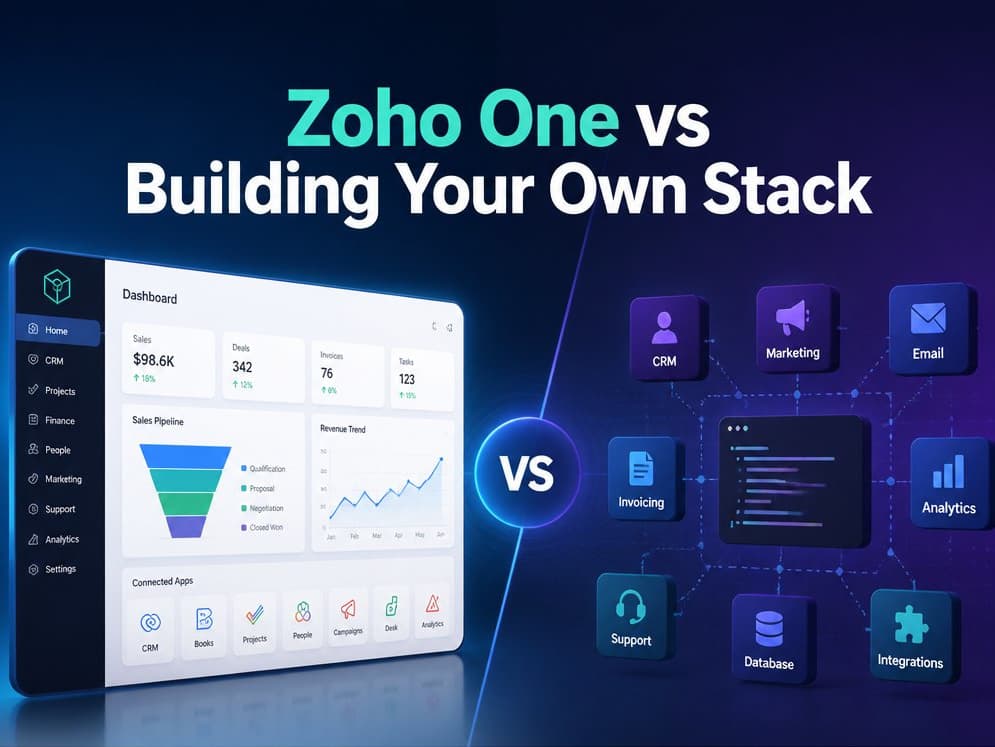
Year one Zoho One wins comfortably. Year three is a different spreadsheet — here is the three-year model to run on your own numbers.
Zoho One vs Building Your Own Stack: A Three-Year Cost Model
Zoho One is the best-value bundle in business software, and I say that as someone who builds the alternative. Forty-odd applications for the price of one seat on most enterprise tools is not a trick — it is a genuinely good deal for a company that fits it.
The problem is that nobody buys software for one year. Zoho One vs building your own stack is a three-year question, and the two answers cross over somewhere between year two and year four for most of the companies that ask me. Year one, the bundle wins comfortably. Year three, you're often paying a subscription plus a developer to make the subscription behave.
By the end of this post you'll have a cost model you can run on your own numbers, and a clear signal for which side of the crossover your company sits on.
Tip
TL;DR — Model three years, not one. Include seat growth, the connector and add-on tax, the consultant days you'll spend on customisation, and the cost of the integration you can't get. If your process is standard, the bundle wins outright. If your differentiator lives inside your workflow, the crossover arrives faster than the sales deck suggests.
The year-one comparison nobody argues with
Take a 25-person company. Sales, operations, finance, a bit of marketing.
| Line | Zoho One | Own stack |
|---|---|---|
| Year-one software | Predictable per-user annual fee | Build cost, paid once |
| Time to first use | Days | Weeks to months |
| Up-front cash | Low | High |
| Risk if you're wrong | Cancel the renewal | You own a thing you don't want |
There's no honest way to make building look better on that table. If cash is tight, if the process isn't settled, if you're pre-product-market-fit — buy the bundle. That's the same conclusion I reached in the Zoho versus custom CRM comparison, and nothing since has changed it.
The interesting question starts when you extend the table.
The four costs that don't appear in the per-seat price
1. Seat growth compounds
The bundle is priced per employee, and most bundles require all employees, not just the ones who use it. Grow from 25 to 60 people over three years and your software bill grows 140% while your usage of the software may not have changed at all. A built system's cost is largely indifferent to headcount.
2. The connector tax
The bundle covers a lot, but every serious deployment I've seen ends up paying for something outside it: a marketing tool the team refuses to give up, a local accounting package for compliance, a WhatsApp gateway, an e-signature service. Then you pay a middleware subscription to keep those in sync — which is exactly the point where automation platforms stop being cheap.
3. Customisation is consulting, and consulting recurs
Scripting, custom modules, and workflow rules are real capabilities — and each one is a small piece of bespoke software with no tests, living inside a platform that updates on its own schedule. You will pay for that maintenance either in consultant days or in an internal person's attention. Track it. Most companies discover it's the second-largest software line item and it never appeared in any comparison.
4. The thing you can't do
Every bundle has a wall. Usually it's a data model constraint: your business needs an object relationship the platform doesn't express, so you fake it with a text field, and every report downstream inherits the lie. The workaround has a cost, paid in people's time, forever.
A three-year model you can actually run
Fill this in with your own numbers. It takes twenty minutes and it's the only version of this comparison worth trusting.
BUNDLE PATH (3 years)
  seats_y1 * price * 12
+ seats_y2 * price * 12          <- use your real hiring plan
+ seats_y3 * price * 12
+ add-on subscriptions * 36      <- middleware, WhatsApp, e-sign, storage tiers
+ implementation consultant days * day_rate
+ annual customisation days * day_rate * 3
+ workaround_labour_hours * loaded_hourly_cost
= TOTAL BUNDLE

BUILD PATH (3 years)
  build cost (one-off)
+ hosting * 36
+ maintenance retainer * 36      <- budget 15-20% of build cost per year
+ change requests year 2-3
+ internal admin time
= TOTAL BUILD
Two rules make the model honest:
- Use your hiring plan, not today's headcount. This single line moves the answer more than anything else.
- Count workaround labour. If two people spend an hour a day re-keying or reconciling because the tool can't do something, that's roughly a full salary over three years. It belongs in the bundle column.
Note
The build column has a real risk premium the bundle doesn't: a project that overruns or gets abandoned. Discount it accordingly — but note that the fix is scoping discipline, not avoiding the option.
The signal that decides it
Forget the spreadsheet for a second. There's one question that predicts the outcome better than the arithmetic:
Is your workflow the reason customers choose you?
If your process is ordinary — leads come in, you quote, you follow up, you invoice — then a standard tool models it fine and you should buy. If the sequence your team follows is the thing competitors can't copy, then bending a generic platform to fit it costs you twice: once in fees, once in the friction of pretending.
The middle case is the common one: mostly standard, with one or two operations that are genuinely yours. The best answer there is usually neither pure option — keep the bundle for finance and support, build the one system that carries your differentiator, and connect them properly. Hybrid is not a compromise; it's often the correct architecture.
When to move off the bundle
Signals that you've crossed over, in rough order of how often I see them:
- Your annual bundle bill exceeds what a purpose-built system would cost to build.
- More than one person's job is mostly moving data between tools.
- You've been told "the platform can't do that" about something core twice in a year.
- Reporting requires an export to a spreadsheet before anyone trusts it.
- Renewal negotiations have become a real line in your budget planning.
Two of those is a conversation. Four is a decision. And if you're mainly comparing against enterprise CRM suites rather than a bundle, the Salesforce and HubSpot comparison runs the same maths at a different price point.
Wrapping Up
Zoho One wins year one on every axis that matters when you're small and unsure. The build wins later, if and only if your process is worth protecting and your headcount is growing. The mistake is not picking the wrong one — it's making a three-year commitment using a one-year comparison.
Run the model above on your own hiring plan before your next renewal. If the crossover lands inside three years, you've got time to plan a migration instead of reacting to a bill.
Want the model run against your numbers? See the sales systems we build or get in touch.
Related Posts
Related Articles
Building a Unified Inbox for Dental Clinics: Facebook, Instagram, and WhatsApp in One Patient Record
A patient DMs your Instagram, WhatsApps a question weeks later, then calls to book, three touchpoints your front desk sees as three strangers. Here's how a real unified inbox merges WhatsApp, Instagram, and Facebook into one patient record, built on official APIs instead of fragile integration.
Specialized CRM vs. General-Purpose CRM: What Actually Fits a Gulf SMB
Not every business runs on a sales pipeline. A breakdown, from a decade building both general-purpose and specialized multitenant CRMs for Gulf SMB verticals, of when Zoho/HubSpot fits and when your workflow has quietly outgrown it.
AI Assisted CRM for Dental Clinics in Qatar in 2026: A Practical Guide
Patients researching dental care increasingly ask an AI assistant first, and being visible there depends on having clear, structured, accurate information about your clinic publicly available services.