

Sales Pipeline Stages: Finding Where Your Deals Actually Die
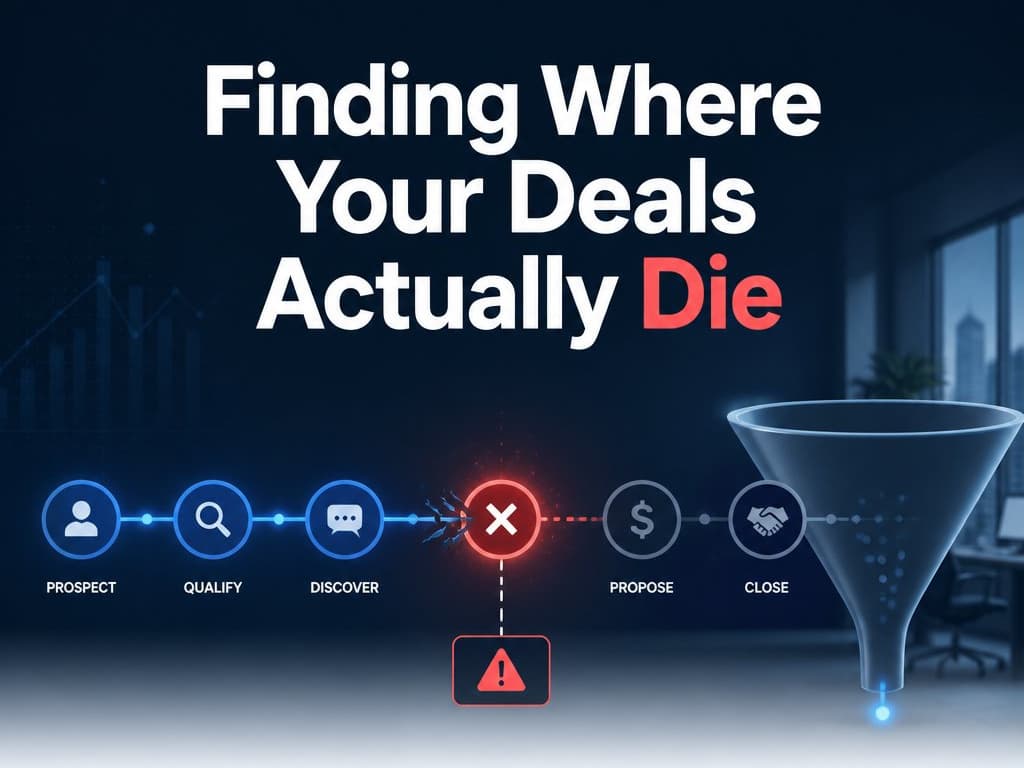
Ask a team where their deals die and you get shrugs. A CRM pipeline exists to replace those shrugs with an answer you can fix.
Ask most small business owners where their deals die and you'll get a shrug. "People just go quiet, I guess." I've heard that sentence, almost word for word, from clinic owners, agency founders, and real estate teams, and it's always delivered with the same resigned tone, as if leads evaporating were weather.
That shrug is expensive, and it's exactly the thing sales pipeline stages exist to replace. A pipeline is nothing more than the stages an enquiry passes through on its way to becoming money, written down and counted. There's no magic in the concept.
The value isn't in the stages themselves. It's in finally seeing the numbers between them, because the numbers between stages are where the money leaks.
Tip
TL;DR — Five stages (new lead → contacted → qualified → proposal sent → won or lost), every enquiry logged with a date, and one rule: nothing sits untouched for more than two days. The stage-to-stage numbers, not the stages themselves, tell you where deals actually die — and the answer is almost never "we need more leads."
The Five Sales Pipeline Stages, Defined
| Stage | What it means | The number to watch |
|---|---|---|
| New lead | Someone raised a hand — a form, a call, a WhatsApp message | How many arrive, and when |
| Contacted | You've actually replied | Time to first response |
| Qualified | Real need, real budget, real authority to say yes | What share of leads survive |
| Proposal sent | A number is on the table, ball in their court | Days sitting without follow-up |
| Won / Lost | Closed either way | Why you lost, in your own words |
A new lead is someone who raised a hand — a form submission, a phone call, a WhatsApp message — with nothing qualified about them yet.
Contacted means you've actually replied, and the clock that runs between those first two stages turns out to matter more than almost anything else in the whole system, which I'll come back to.
Qualified means they're real: they have the need, the budget, and the authority to say yes, which is the stage that filters the tire-kickers from the buyers. Proposal sent means a number is on the table and the ball is in their court.
And then won or lost, where the discipline is recording why you lost, because those reasons, read back over a quarter, are a to-do list for fixing your business.
Nothing clever, as I said.
Why the Numbers Between Stages Beat the Stages Themselves
When I build a CRM for a client, the first month of real data almost always tells a story nobody in the room expected. A list of names in a spreadsheet tells you who. Stage data with dates on it tells you where and how long — and that's the part you can act on.
The Clinic That Thought It Had a Lead Problem
My favorite example is a clinic that came to me convinced they had a lead problem. They wanted more marketing, more ads, more volume at the top of the funnel, and they were ready to spend for it.
Then the pipeline data came in, and it said something different: they had plenty of leads. What they had was a speed problem. Enquiries that got a reply within the first hour booked at several times the rate of enquiries answered the next morning. Same service, same prices, same staff. The patients who messaged at 9pm and heard nothing until 10am had simply booked with whoever answered first, because from the patient's side, responsiveness reads as competence.
The Fix Was Speed, Not Spend
The fix wasn't more leads and it wasn't more staff. We automated the first response, so every enquiry got an immediate, useful reply at any hour — the same case I make for an AI chatbot on your website when the enquiries arrive after closing time. Then we set follow-up reminders so nothing sat untouched while a receptionist was busy with the person standing in front of her.
Revenue moved within weeks. Same leads, same team, same ad spend. The leak was one stage wide, and once you could see it, closing it was almost mundane. It's the same system I later built out for a multi-branch dental clinic, where reception, doctors, and owners all work the pipeline from one place.
The Pattern: One Stage Is Quietly Leaking
That's the pattern I see over and over. The fix is rarely "get more leads," even though that's what nearly every business asks for first, because it's the only lever they can see without stage data.
It's one specific stage quietly leaking:
- Deals sitting too long before first contact.
- Proposals going out and never being followed up.
- Qualified leads waiting on a quote that takes a week.
You can't see any of that in a spreadsheet of names, and you can't fix what you can't see.
How to Find Where Your Deals Actually Die
Here's a fair test you can run on yourself right now. Can you say, without opening anything, how many open deals you have and which stage is holding the most stuck ones?
If you can, your current system is doing its job, and honestly, keep it. If you just winced, that wince is the gap between you and the version of your business that answers in an hour and follows up on time.
Start simple:
- Five stages, no more. New lead, contacted, qualified, proposal sent, won or lost.
- Log every enquiry with a date. No date, no diagnosis — the dates are what turn a list into stage data.
- One rule: nothing sits untouched for more than two days. Enforce it with reminders, not willpower.
- Read the lost reasons monthly. A quarter of them in one place is a to-do list, not a graveyard.
That alone puts you ahead of most of the businesses you compete with.
FAQ: Sales Pipeline Stages
What are the five stages of a sales pipeline?
New lead, contacted, qualified, proposal sent, and won or lost. Most businesses need nothing more than these five, and the names matter far less than logging a date on every move between them.
How do I know which pipeline stage is losing deals?
Count how many deals enter each stage and how many leave it, then look at how long the stuck ones have been sitting. The stage with the biggest drop-off, or the longest average wait, is your leak. One month of honest data is usually enough to see it.
How many sales pipeline stages should I have?
Five is right for most small businesses. More stages feel thorough but get skipped under pressure, and a stage nobody updates is worse than no stage at all — it makes the data look complete when it isn't.
Do I need a CRM to track pipeline stages?
Not to start — a spreadsheet with a date column beats nothing. You'll want a CRM once you need reminders that fire on their own and reports you don't have to assemble by hand, which is usually the point where the off-the-shelf options start to stop fitting a growing team.
Wrapping Up
A pipeline doesn't sell anything for you. What it does is replace "people just go quiet, I guess" with a specific stage, a specific number, and a fix that's usually smaller than the marketing budget you were about to spend. The clinic didn't need more leads — it needed to answer the phone faster, and it took stage data to prove it.
Set up the five stages this week, log the dates for a month, and let the numbers tell you which stage is costing you money.
I build CRMs around exactly this — see what it did for a two-branch dental clinic, or tell me about your pipeline.
Related Articles
Building a Unified Inbox for Dental Clinics: Facebook, Instagram, and WhatsApp in One Patient Record
A patient DMs your Instagram, WhatsApps a question weeks later, then calls to book, three touchpoints your front desk sees as three strangers. Here's how a real unified inbox merges WhatsApp, Instagram, and Facebook into one patient record, built on official APIs instead of fragile integration.
Specialized CRM vs. General-Purpose CRM: What Actually Fits a Gulf SMB
Not every business runs on a sales pipeline. A breakdown, from a decade building both general-purpose and specialized multitenant CRMs for Gulf SMB verticals, of when Zoho/HubSpot fits and when your workflow has quietly outgrown it.
AI Assisted CRM for Dental Clinics in Qatar in 2026: A Practical Guide
Patients researching dental care increasingly ask an AI assistant first, and being visible there depends on having clear, structured, accurate information about your clinic publicly available services.