

ERP Implementation Failure: Why UAE Projects Go Wrong
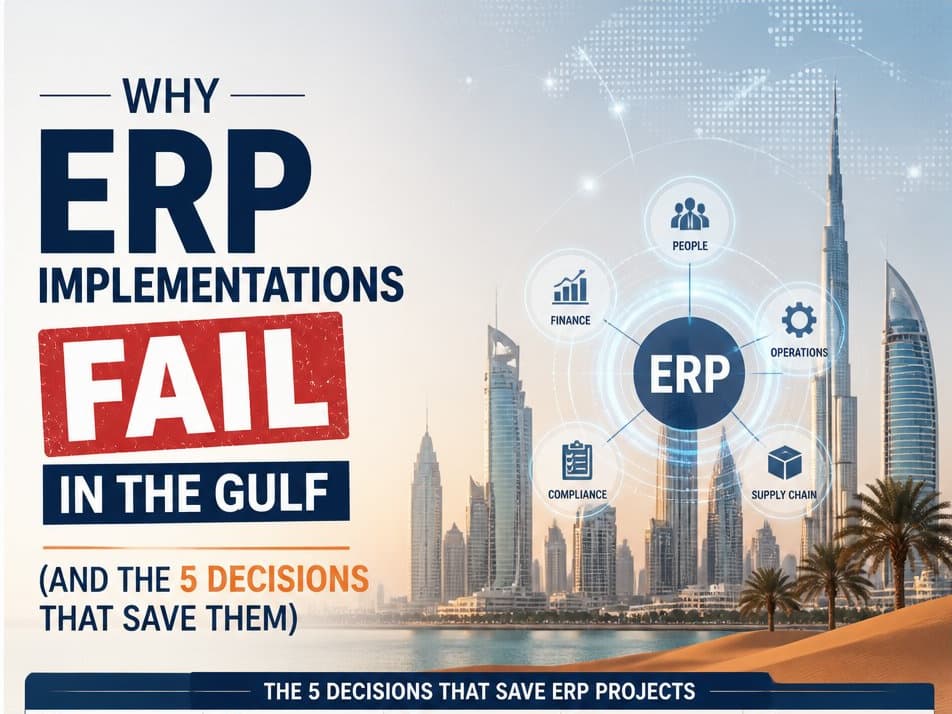
Two-thirds of ERP projects miss their targets, and the software is almost never the reason. Here's what actually kills them, and how to avoid it.
ERP Implementation Failure: Why UAE Projects Go Wrong
If you're reading about ERP implementation failure, you're usually in one of two places: mid-project and watching the timeline slide, or pre-signature and quietly nervous about signing.
Here's the uncomfortable part. ERP projects almost never collapse because the software was bad. SAP Business One, Odoo, Microsoft Dynamics 365 Business Central, Oracle NetSuite, Zoho One and Sage all work. They collapse on decisions made — or dodged — in the first six weeks, before anyone logs into a system.
The pattern is sharpest with ERP for SMEs in UAE, where a 40-person trading company buys the platform a 4,000-person group runs, without the project staff that made it work there.
By the end you'll know the five decisions that separate a rollout that lands from one that becomes a two-year renovation.
Tip
TL;DR — ERP projects fail on ownership, process mapping, data quality, scope creep and go-live strategy, not on features. Budget one to two times the licence cost for implementation, name one internal owner with real authority, clean your master data before migration, and roll out module by module.
Why ERP Projects Fail: The Real Causes of ERP Implementation Failure
Every vendor deck opens with a failure statistic, so be precise about what it means. Panorama Consulting's 2025 study put the ERP failure rate at roughly 68%, and Gartner has for years placed "fails to meet its stated objectives" in the 55–75% band. Roughly half run over budget.
"Failure" almost never means the system doesn't switch on. It means one of these:
- Go-live slipped by two or more quarters.
- The budget landed at a multiple of the signed number.
- Staff quietly kept running the old spreadsheets alongside it.
- The promised reporting never materialised because the data going in was wrong.
None of those are software defects. They're organisational failures wearing a software costume: you aren't buying a product, you're funding a change management project.
The ERP Implementation Cost UAE Budgets Always Miss
The quoted licence fee is the part everyone plans for. The ERP implementation cost UAE businesses actually incur is one to two times that figure in year one, hidden in line items that never reach the board slide.
| Cost line | Typically budgeted? | Why it bites |
|---|---|---|
| Licences / subscription | Yes | The only number in the proposal |
| Implementation & configuration | Sometimes | Often 1–2x licence cost |
| Data cleanup & migration | Rarely | The biggest overrun driver |
| Backfilling staff time | Almost never | Best people on the project, not their day job |
| Integrations | Sometimes | Bank feeds, portals, e-invoicing, WhatsApp |
| Training & post-go-live support | Rarely | Adoption dies without it |
Backfilling staff time is the line founders refuse to price. Your finance manager cannot spend three days a week on business process mapping and close the month. Pretending that's free is how projects lose a quarter.
Warning
A proposal that quotes licences and implementation but says nothing about data migration, training or integrations isn't cheaper. It's incomplete, and the gap arrives later as a change request.
The Five Decisions: An ERP Implementation Checklist
Most of what goes wrong traces to five decisions. Treat this as your ERP implementation checklist for the phase before you sign.
1. Who owns this internally?
One named person, senior enough to overrule a department head, with a formal reduction in their day job. Not "the finance manager, on top of everything else." Not a committee. Not the vendor — a vendor cannot make your sales team change how they quote. If you can't name that person and free their calendar, you aren't ready to start.
2. Have you mapped the process you actually run?
Not the process in the SOP folder — the real one, including the workaround your warehouse supervisor invented in 2021 that everything now depends on. Business process mapping before demos means you evaluate vendors against your reality instead of being walked through theirs.
It also forces an honest question: which processes are genuinely differentiated, and which are just habit? Habit bends to the software.
3. Which modules, in which order?
Almost nobody needs finance, inventory, procurement, HR and manufacturing live on the same day. Pick where the pain is loudest and the data is cleanest — usually finance — and sequence the rest behind it. Every module added to phase one multiplies what can go wrong at once.
4. What is your data standard, and who enforces it?
Decide before migration what a valid customer, item and supplier record looks like, then name the person who rejects records that don't. Master data without an owner degrades within a quarter of go-live.
5. How will you go live?
Phased or big bang, decided deliberately and early — it shapes budget, timeline and training.
Dirty Spreadsheets: Where ERP Data Migration Actually Breaks
Here's the scene that plays out in nearly every stalled project. Week nine, the ERP data migration starts, and the legacy system migration reveals what was really in there: the same customer under four spellings, item codes encoding a warehouse layout that no longer exists, a phone number in the VAT field.
Nobody budgeted for it because nobody looked before signing. And it doesn't stay a data problem — it becomes a trust problem. The first report the new ERP produces is wrong, a manager notices, and half the team goes back to their spreadsheet "just to check." That's how user adoption dies: not with a refusal, but with a parallel system nobody admits to running.
Three things prevent that:
- Audit before you sign. Count the duplicates, blank required fields and free-text columns in your master data. That count predicts your timeline better than any vendor estimate.
- Clean in the old system, not during migration. Cleaning mid-migration means doing it twice.
- Migrate less than you think. Open transactions, current master data, and a defined window of history. Ten years of closed records belongs in an archive, not your new ERP.
Important
Bad data is the most expensive thing you can carry into a new system and the cheapest thing to fix before you start. Do the audit in week one, not week nine.
"We'll Customize It Later": The Custom ERP vs Off-the-Shelf ERP Trap
The most dangerous sentence in an ERP evaluation is "it can't do that today, but we'll customize it later." It closes the deal and opens the trap: "later" means after the budget is committed and your leverage is gone.
The real custom ERP vs off-the-shelf ERP question is simple: how much of your process does the standard product cover, honestly, with no customization at all?
| Standard product covers | The right move | The failure mode |
|---|---|---|
| Roughly 80%+ | Take it off the shelf, adapt your process | Customizing a fit that already works |
| Roughly 50–80% | Standard core, custom at the edges | Rebuilding the platform inside itself |
| Below 50% | Seriously price a custom build | Paying licences forever to fight the product |
The trap is the middle band handled badly: teams buy a platform covering half their needs, then spend two years turning it into something they should have bought differently. Every customization is a permanent tax, retested and often reworked at every upgrade.
The same dynamic plays out with sales software — see Zoho CRM vs Custom CRM UAE: Why Big Software Can Be a Trap. The ERP version is the same trap with a bigger invoice.
Phased vs Big Bang ERP Implementation: Choosing Your Go-Live
The phased vs big bang ERP implementation debate has a default answer for SMEs — phased — but know what you're trading.
| Big bang | Phased | |
|---|---|---|
| Go-live risk | Concentrated on one date | Spread across modules |
| Total duration | Shorter | Longer overall |
| Cost of parallel running | None | Real — two systems for months |
| Recovery if it goes wrong | Very hard | Roll back one module |
Big bang makes sense when the business fits in a room, processes are simple, and the legacy system can't run past a date. Everywhere else, phased wins because it keeps failure survivable: when a phased rollout goes wrong, one module goes wrong. When a big bang goes wrong, you can't invoice.
Whichever you pick, don't go live in your busiest month, or the week your project owner is on leave. Obvious, and it happens constantly.
ERP vs CRM: Don't Buy One to Fix the Other
The ERP vs CRM distinction in practice: an ERP runs what the business has and owes — finance, inventory, procurement, payroll. A CRM runs what it's trying to win — leads, pipeline, follow-ups. Operator-specific tools sit in the gap, which is why Real-Estate Management Software for Multi-Property Operators is its own category rather than an ERP module.
Diagnose before you shop. "We don't know what stock we have and month-end takes three weeks" is ERP. "Leads go cold and nobody knows why" is CRM — a far cheaper fix.
ERP E-Invoicing UAE: The Deadline Now Driving Projects
A live compliance driver is pushing UAE ERP projects forward right now. The e-invoicing mandate uses a Peppol-based five-corner model: invoices move through an Accredited Service Provider (ASP) rather than being emailed as PDFs. It sits under Ministerial Decisions 243 and 244 of 2025, with penalties set by Cabinet Decision 106 of 2025.
The published timeline as of July 2026:
| Milestone | Date |
|---|---|
| Voluntary pilot phase | Live since July 2026 |
| Appoint an ASP (revenue ≥ AED 50m) | 30 October 2026 |
| Mandatory go-live (revenue ≥ AED 50m) | 1 January 2027 |
| Appoint an ASP (all other businesses) | 31 March 2027 |
| Mandatory go-live (all other businesses) | 1 July 2027 |
| Government entities | 1 October 2027 |
For ERP e-invoicing UAE planning the implication is simple: your ERP must emit structured invoice data an ASP can transmit, with the mandated fields populated correctly. If your go-live sits near your compliance date, you're stacking two hard deadlines on one finance team — sequence them, or pick a platform with a proven ASP integration and make compliance part of phase one.
Warning
These dates have already moved once — the large-business ASP deadline shifted from July to October 2026. Confirm the current position with the Ministry of Finance or the Federal Tax Authority before building a plan around them.
A Realistic ERP Implementation Timeline
An honest ERP implementation timeline for a UAE SME running finance and inventory in phase one:
| Phase | Realistic duration | What kills it |
|---|---|---|
| Process mapping & selection | 4–8 weeks | Skipping it to "save time" |
| Data audit & cleanup | 4–8 weeks (parallel) | Starting it in month three |
| Configuration & build | 8–16 weeks | Scope creep, no change control |
| Testing with real data | 3–6 weeks | Testing with sample data instead |
| Training & go-live | 2–4 weeks | Training once, weeks too early |
| Stabilisation | 4–8 weeks | Standing the team down at go-live |
Six to nine months end to end for a focused two-module scope. Anyone promising a full multi-module ERP in six weeks is describing an installation, not an implementation. The compression that works isn't rushing phases — it's cutting scope.
FAQ
How long does an ERP implementation take? For a UAE SME with a focused two-module scope, six to nine months from selection to a stable go-live. Single-module rollouts on clean data can land in three to four months. Multi-entity projects run twelve months and up.
What percentage of ERP implementations fail? Industry research puts it high: Panorama Consulting's 2025 study reported around 68%, and Gartner has long cited a 55–75% range for projects failing to meet stated objectives. "Failure" usually means overrun or low adoption, not a system that won't run.
How much does ERP cost for a small business in UAE? Plan on the licence cost plus one to two times that figure for implementation in year one, then ongoing licences and support. The variable that moves the number most is data quality, not headcount.
Why do ERP projects go over budget? Four recurring reasons: data cleanup nobody scoped, scope creep with no change control, integrations discovered mid-project, and staff time that was never priced.
Who should own an ERP project internally? One senior person with authority to overrule department heads and a formal reduction in their workload. Committees stall on cross-department decisions, and a vendor cannot force your team to change how they work.
Can you implement ERP without a consultant? For a single module on clean data with a technical internal owner, yes. Beyond that it's usually false economy — fees saved reappear as a longer timeline and a rework bill. If you go alone, at minimum buy an independent review of your process map and data model first.
How to Vet an ERP Consultant in Dubai
A good ERP consultant Dubai side pushes back on your scope and insists on process mapping before demos. One who agrees with everything in the first meeting is selling licences, not an outcome. Ask which module they'd cut from phase one.
Wrapping Up
ERP implementation failure is remarkably predictable, and that's the good news. The projects that go wrong nearly always skipped the same things: a named internal owner, an honest process map, a data audit before signing, a scope with a boundary, and a go-live plan that could survive a bad week.
None of those depend on which vendor you pick. Get them right and your platform choice matters far less than the sales deck suggests.
Planning an ERP rollout or trying to rescue one? See more projects or get in touch.
Related Posts
Related Articles
ERP vs. Custom Software for Egyptian SMEs: When the E-Invoice (ETA) Mandate Changes the Math
Egypt's e-invoicing mandate stopped being a compliance formality and became a live, real-time integration with the ETA platform — and that shift quietly changes the ERP-vs-custom calculus for Egyptian SMEs.
ERP Implementation Cost in Saudi Arabia: What the Licence Price Hides
The licence is about a third of the bill. Data migration, ZATCA integration, Arabic localisation and training are the rest — here is how to price them.
ZATCA Phase 2 Integration: A Technical Guide for Saudi Businesses
What ZATCA Phase 2 integration actually requires from your ERP or POS — the XML, the cryptographic stamp, the API calls, and where it breaks.