

Qatar PDPL and Data Residency: Where Your CRM Is Allowed to Live
Qatar is not Saudi. There is no general data-localisation rule, special-category data needs permission, and QFC entities follow a different regime.
Qatar PDPL and Data Residency: Where Your CRM Is Allowed to Live
If you copied a Saudi data-residency checklist and applied it to Qatar, you are probably overbuilding the wrong parts and missing the ones that matter.
Qatar is not Saudi. There is no general rule forcing customer data to stay inside the country. Cross-border transfers are allowed, with an important exception for sensitive data. QFC entities follow a separate regime. And the regulator's cloud guidance is more interested in security and classification than in the physical location of the server.
That does not make compliance optional. It makes it specific. A Qatar PDPL compliance software decision is really three decisions: what data you hold, where it may go, and what evidence you can produce when someone asks.
This guide separates the mainland regime from the QFC regime, explains what the PDPPL actually requires, compares hosting models, and gives you the questions to ask a CRM vendor without accepting "we are compliant" as an answer.
Tip
TL;DR, Qatar does not require local hosting by default. It requires lawful processing, protection for sensitive data, and a defensible transfer and retention story. Do not buy data residency you do not need, and do not skip the controls you do.
Warning
This is an engineering and procurement guide, not legal advice. Confirm your obligations with Qatar's competent authority or counsel, especially for special-category data, QFC entities, and cross-border transfers.
The assumption that Qatar is Saudi
Saudi PDPL conversations often start with residency because the Kingdom has explicit rules and a strong localisation expectation. Teams then assume Qatar works the same way. If you have already read where a Saudi CRM is allowed to live, resist the urge to reuse the checklist.
It does not. Qatar's Personal Data Privacy Protection Law, Law No. 13 of 2016, sets out processing principles, consent, security, and transfer rules. The Communications Regulatory Authority's Cloud Policy Framework, issued in 2022, explicitly moved away from treating local storage as the default requirement. The emphasis is on classification, encryption, access control, and secure regions rather than a blanket "data must stay here" rule.
The practical consequence: a vendor that sells you an in-country data centre may be solving a problem you do not have. A vendor that stores data abroad without a transfer assessment may be creating one you do.
What Qatar's PDPPL actually requires
The law is built around familiar principles: process personal data lawfully and for a defined purpose, collect only what you need, keep it accurate, protect it, retain it only as long as necessary, and be able to explain what you did.
For a CRM, those principles turn into concrete questions:
- What personal data does the CRM hold, and why?
- Who inside the company can see it, and who outside?
- How is consent recorded, and how is it withdrawn?
- How long is data retained after a customer leaves?
- What happens when a customer asks for a copy or deletion?
- Which third parties receive the data, and under what terms?
Most CRM projects answer the first question and skip the rest. The system stores names, phone numbers, emails, conversation histories, and sometimes health or financial details. The team knows it is "customer data." Nobody has classified it.
Classification is the first control because it determines the transfer rule. Ordinary personal data can generally be transferred abroad under the PDPPL framework. Data of a special nature is treated differently and requires prior permission from the competent authority. If your CRM holds clinic notes, financial details, or other sensitive categories, the hosting decision changes.
Mainland Qatar vs the QFC
Qatar has two data-protection regimes, and the one that applies depends on where the entity operates.
Mainland entities fall under the PDPPL and the competent authority. Entities licensed in the Qatar Financial Centre fall under the QFC Data Protection Regulations 2021, administered by the QFC Data Protection Office. The QFC regime has its own registration, notification, and transfer expectations.
This matters for group structures. A holding company, a QFC subsidiary, and a mainland operating company may each have a different answer. A CRM shared across them needs a data map that reflects the legal entity, not just the office address.
If you operate only on the mainland, do not let a QFC-focused vendor sell you a QFC compliance package. If you operate in the QFC, do not assume the mainland guidance is sufficient.
Cross-border transfers and special-category data
The transfer question is where most of the confusion lives. The short version:
- There is no general localisation requirement that forces all CRM data to remain in Qatar.
- Transfers are permitted under the PDPPL framework, subject to the conditions in the law and the protections you apply.
- Special-nature data has a stricter path, including prior permission from the competent authority.
- The QFC regime has its own transfer rules.
The practical work is to document the transfer rather than assume it. That means knowing which data goes where, which provider and sub-processors are involved, what security controls apply, and how you would respond if the data subject or the regulator asked.
A useful test: can you produce a one-page data map for your CRM in an afternoon? If not, the transfer story is being managed in people's heads.
What "data residency" means in practice
Data residency usually means the primary storage location. That is only one part of the picture. A CRM also has backups, disaster recovery, logs, support access, analytics, and email or messaging integrations. Each can move data across borders.
Ask five questions:
- Where is the primary database hosted?
- Where are backups and disaster-recovery copies stored?
- Can vendor support staff access the data, and from where?
- Which sub-processors receive data, and for what?
- What happens to the data when the contract ends?
A vendor that answers only question one is giving you a marketing answer. A vendor that answers all five is giving you a compliance answer.
Hosting models compared
| Model | Control | Operational cost | Best fit |
|---|---|---|---|
| Global SaaS | Low | Low | Ordinary data, strong vendor terms, no special-category data |
| Regional cloud | Medium | Medium | Teams that need control without running infrastructure |
| In-country hosting | High | High | Special-category data or a strict contractual requirement |
| Self-hosted | Highest | Highest | Custom systems with sensitive data and in-house operations |
The right answer is the lowest-control model that satisfies your legal and commercial requirements. Moving to in-country hosting "just in case" is expensive and often unnecessary in Qatar. Staying on global SaaS without a transfer assessment is cheap until it is not. The same logic applies when a UAE business weighs a large suite against a smaller build in Zoho CRM vs Custom CRM UAE: the platform is not the strategy.
What Qatar PDPL compliance software must actually do
A CRM does not need a "PDPL mode." It needs the controls that make compliance possible:
- Data inventory: every field classified, with a purpose and retention period.
- Access control: role-based permissions, audit logs, and a record of who viewed or exported data.
- Consent and preference history: what the customer agreed to, when, and through which channel.
- Retention and deletion: automated rules, not a manual quarterly cleanup.
- Export and portability: a complete export in a usable format, including attachments and history.
- Transfer records: where data is stored, which sub-processors are involved, and what safeguards apply.
- Incident evidence: logs that let you reconstruct what happened without guessing.
If a vendor cannot demonstrate these, the compliance claim is a policy document, not a product capability. The same gap appears in why off-the-shelf CRMs stop fitting growing teams, especially when the team grows across entities and countries.
The vendor questionnaire
Send these before the demo, and ask for written answers:
- Which legal entity hosts the data, and in which country?
- Where are backups and disaster-recovery copies stored?
- Which sub-processors receive personal data, and what do they do with it?
- Can we restrict support access to named staff, and do you log it?
- How do you handle a deletion or export request, and how long does it take?
- What happens to our data at contract termination?
- Can you provide a data-processing agreement that reflects Qatar's requirements?
- Which security certifications or audit reports can you share?
A vendor who cannot answer these is not necessarily unsafe. They are unprepared, and unprepared vendors become your project risk. In Qatar's dental and clinic market, the same questions apply to patient data, see the existing guide to CRM for dental clinics in Qatar and the AI-assisted CRM guide for Qatari clinics.
The evidence to keep
Compliance is not a one-time project. Keep a small, current evidence pack:
- The data map and classification.
- The retention schedule.
- The transfer assessment and sub-processor list.
- The access-control matrix.
- The incident and deletion procedures.
- The latest security report or certification.
Review it when you add a new integration, change hosting, or enter a new market. The pack should be short enough that someone can actually read it.
Wrapping Up
Qatar's data rules are not a copy of Saudi's. There is no blanket localisation requirement, but there are real obligations around sensitive data, transfers, and controls. The hosting decision should follow the data classification, not the other way around.
Start with the data map. Then decide whether you need regional or in-country hosting. Then make the vendor prove the controls.
Choosing a CRM for Qatar? See the systems we build or get in touch to review your data map and hosting options before you sign.
Related Posts
Related Articles
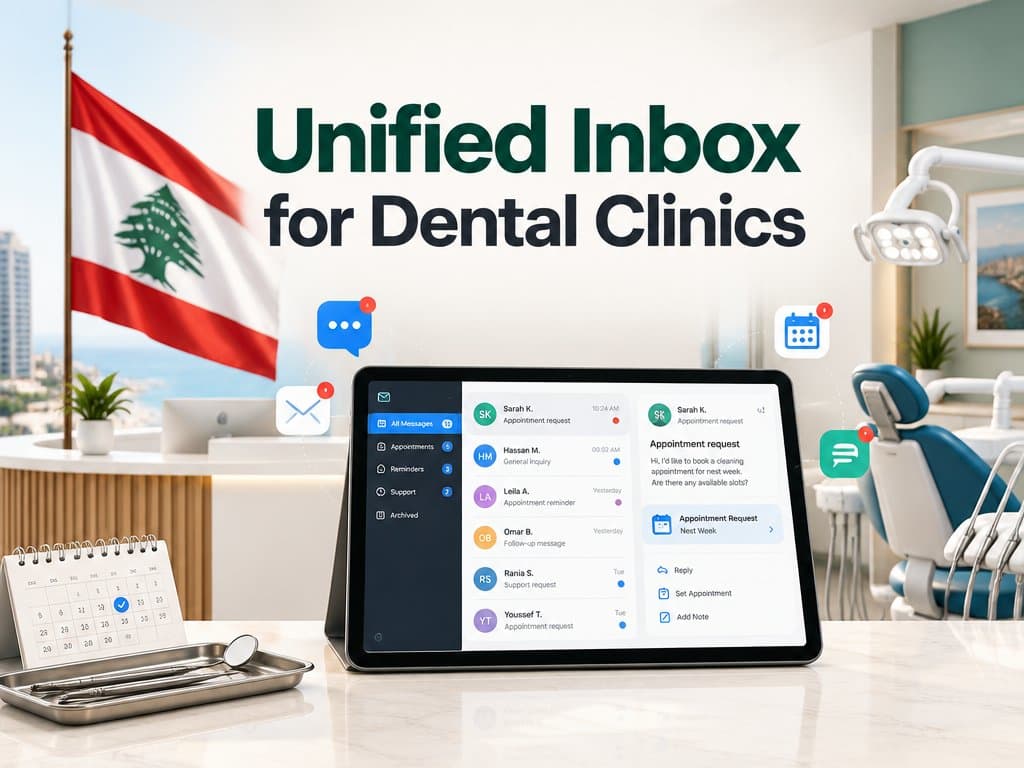
Building a Unified Inbox for Dental Clinics: Facebook, Instagram, and WhatsApp in One Patient Record
A patient DMs your Instagram, WhatsApps a question weeks later, then calls to book, three touchpoints your front desk sees as three strangers. Here's how a real unified inbox merges WhatsApp, Instagram, and Facebook into one patient record, built on official APIs instead of fragile integration.
How I Scope a CRM Project: My Discovery Process, Step by Step
Exactly what happens in the first two weeks of a CRM project, the questions, the data audit, and the written scope that prevents scope creep.

CRM for Training Centres and Private Academies
Enrolment, instalments, attendance, and re-enrolment are one funnel. Most academies run them as four disconnected systems and lose revenue in the gaps.